


A digital product may look complete, perform well during a demonstration, and still carry significant hidden risk. That risk often develops when teams move quickly without thoroughly validating functionality, usability, security, compatibility, or performance.
These unresolved quality concerns do not always produce immediate failures. Instead, they accumulate quietly inside the product. Over time, every skipped test, incomplete requirement, unverified assumption, and postponed defect contributes to what can be described as quality debt.
Like financial debt, quality debt may appear manageable at first. However, the longer it remains unresolved, the more expensive and disruptive it becomes to correct.
What Is Quality Debt?
Quality debt is the accumulated risk created when product decisions are implemented without sufficient validation. It represents the gap between the quality a product currently delivers and the quality required for it to remain reliable, usable, secure, and scalable.
It can develop when deadlines are prioritised over testing, acceptance criteria remain unclear, known defects are repeatedly postponed, or teams rely only on successful user journeys while ignoring edge cases.
Quality debt may exist across the entire customer experience. It can affect functionality, accessibility, user interface consistency, browser compatibility, mobile responsiveness, security, data accuracy, and system performance.
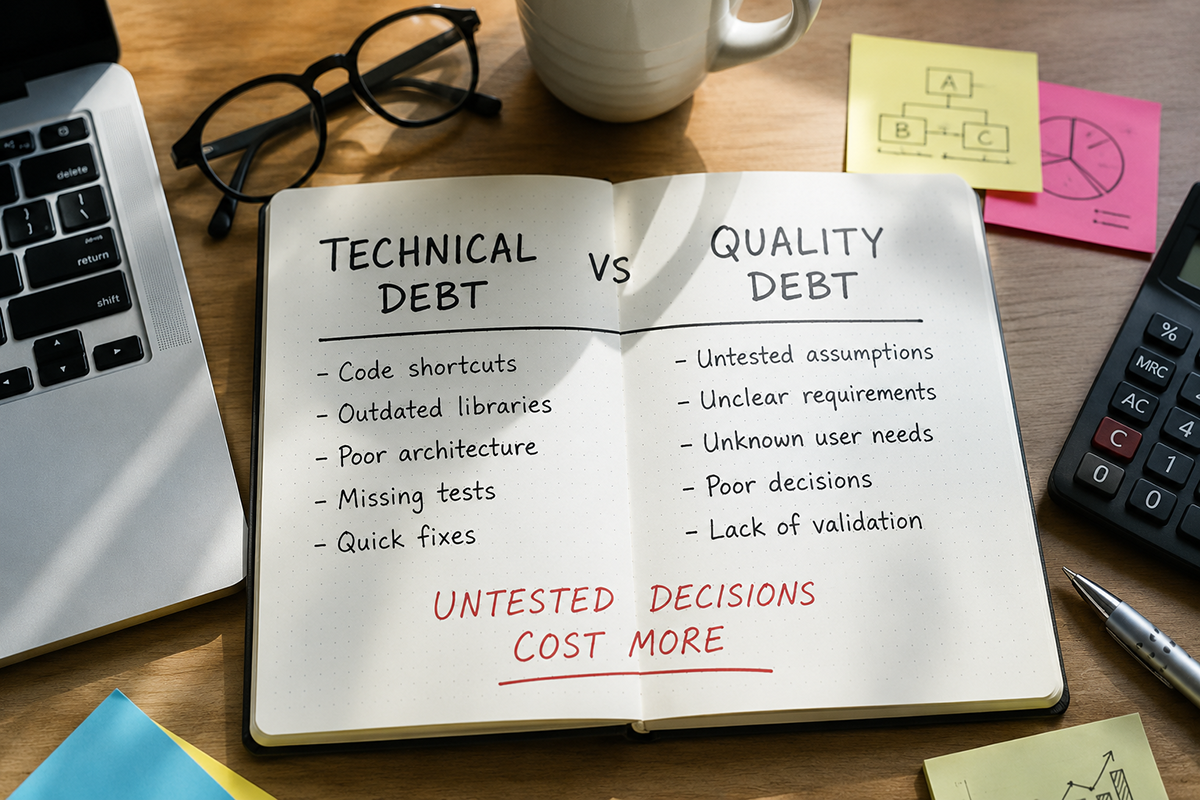
How Technical Debt Is Different
Technical debt usually refers to compromises made within the codebase, architecture, infrastructure, or development process. It may include duplicated code, outdated libraries, temporary integrations, inefficient database queries, or systems that are difficult to maintain.
Quality debt is broader. It concerns whether the product has been adequately evaluated and whether it consistently delivers the experience and outcomes it was designed to provide.
A system can contain clean, well-structured code and still suffer from quality debt when important scenarios have never been tested. Similarly, a technically imperfect system may continue to deliver a dependable user experience when its risks are understood and properly controlled.
“Technical debt affects how a product is built. Quality debt affects whether the product can be trusted.
Why Untested Decisions Become Expensive
Every product decision creates consequences. A small change to a checkout form may affect payment completion. A database modification may influence reporting accuracy. A visual adjustment may reduce accessibility or create inconsistencies across screen sizes.
When these consequences are not tested, the product begins carrying assumptions instead of evidence. The cost appears later through production defects, customer complaints, emergency fixes, abandoned transactions, repeated support requests, and loss of user confidence.
Defects discovered after release are also more difficult to isolate. Teams must investigate live data, reproduce inconsistent behaviour, coordinate urgent deployments, and confirm that the correction has not introduced additional problems.
How Quality Debt Accumulates
Quality debt rarely begins with one major mistake. It normally grows through a series of small compromises that appear reasonable under delivery pressure.
A test case is postponed because the change looks simple. A known defect is accepted because only a small number of users appear to be affected. Regression testing is reduced because the release deadline cannot move. Documentation is left incomplete because the team already understands the feature.
Individually, these decisions may appear harmless. Collectively, they reduce product visibility and make future changes increasingly unpredictable.
The Business Impact of Quality Debt
Quality debt is not only a testing or development concern. It directly affects business performance. Unstable journeys can reduce conversion rates, inaccurate data can weaken decision-making, and inconsistent experiences can damage brand credibility.
Teams carrying significant quality debt also become slower. More time is spent investigating unexpected behaviour, retesting old functionality, handling customer complaints, and correcting issues that should have been prevented earlier.
As confidence decreases, even minor product updates require greater effort because no one can accurately predict which areas may be affected.
Reducing Quality Debt Strategically
Eliminating all quality risk is neither practical nor necessary. The objective is to make risk visible, measurable, and intentionally managed.
Teams should define clear acceptance criteria before development begins, test critical customer journeys continuously, maintain regression coverage, document known limitations, and prioritise defects according to business impact.
Automation can improve speed and consistency, but automated testing should support rather than replace thoughtful quality analysis. Exploratory testing, usability reviews, accessibility validation, and real-world scenario testing remain essential.
Quality Is a Product Responsibility
Quality assurance should not operate only as a final checkpoint before release. Quality must be considered throughout strategy, design, development, testing, deployment, and continuous product improvement.
Designers help prevent quality debt by defining consistent and accessible interactions. Developers contribute by creating maintainable systems and testable components. Product teams establish clear requirements, while quality specialists examine assumptions, identify risks, and validate outcomes.
The strongest digital products are not simply those that launch quickly. They are the products that remain dependable as users, features, platforms, and business expectations continue to grow.